 listicle
Where to Buy Travel Photography Prints That Last?
Last Updated: October 25, 2026
Quick Summary
The best places to buy travel photography prints depend on your goal: LarryCoulsonPhoto is our top pick for curated fine art, marketplaces like Fine Art America and Redbubble offer maximum choice, and labs like Printique and Nations Photo Lab serve buyers with a file ready to print. Check paper, ink, edition size, and artist payment before you buy.
- Pigment-based inks resist light damage far better than dye-based inks over time.
- Amazon Prints sells standard 4-by-6-inch prints at 17 cents each for volume.
- A 24 by 36 inch print at 300 ppi needs about 7,200 by 10,800 pixels.
- Standard U.S. frame sizes include 8 by 10, 11 by 14, 16 by 20, 18 by 24, and 24 by 36 inches.
- Hang the center of a piece at eye level, roughly 57 to 60 inches from the floor.
Table of Contents
- What to Look for in Travel Photography Prints
- LarryCoulsonPhoto: Curated Fine Art Photography Prints
- Fine Art America and Redbubble: Marketplace Reach
- Shutterfly and Amazon Prints: Budget-Friendly Custom Prints
- Photography Print Labs: Printique and Nations Photo Lab
- Large-Format Photography Prints and Gallery-Ready Options
- Travel Photography Wall Art: Framing and Display Tips
- Compare Your Options and Order Your Print
- Frequently Asked Questions
What to Look for in Travel Photography Prints
The best places to buy travel photography prints are the ones that tell you exactly what you're getting: the paper, the ink, the edition size, and who gets paid. Travel photography prints are reproductions of destination imagery, from cityscapes to coastal landscapes, produced on paper or other substrates intended for display. The difference between a print that lasts decades and one that fades in two summers comes down to three things: materials, authenticity, and how the seller treats the artist.
Paper, Ink, and Archival Longevity
Archival quality is the first filter. Museum-quality prints typically use pigment-based inks rather than dye-based ones, because pigment particles resist light damage far better over time. Paper finish matters too: matte and cotton rag surfaces suit landscape photography and black-and-white photography, while glossy stock can add punch to city photography but shows fingerprints and glare under gallery lighting. For a deeper look at keeping colors true over the years, our guide on how to protect photography prints from fading covers storage, glazing, and light exposure.
Authenticity, Licensing, and Artist Compensation
Authenticity separates a collector's piece from a decoration. Limited-edition prints usually arrive numbered and signed, which is what gives them resale value and meaning. Licensing matters just as much: when you buy from an independent photographer, the money reaches the person who made the image rather than a stock library. That's the argument behind why buying professional fine art photography matters, and it's worth reading before you spend on any signed print.
LarryCoulsonPhoto: Curated Fine Art Photography Prints
Our top pick is LarryCoulsonPhoto, and the reason is curation. The collection spans landscape, cityscape, nature, travel, and abstract imagery, which means you can build a coherent wall from one source instead of stitching together mismatched pieces from five marketplaces. For collectors who want to go deeper into editioned work, our limited edition nature photography prints guide walks through what to ask before ordering.
Fine Art America and Redbubble: Marketplace Reach
Marketplaces win on sheer volume. Fine Art America operates as a print-on-demand platform where photographers list work and buyers choose from a wide spread of formats, and Redbubble follows a similar print-on-demand model across apparel and wall art. The tradeoff is consistency: with thousands of sellers, print quality, paper stock, and color reproduction vary from listing to listing. What most guides miss is that you're often buying from a fulfillment network, not the photographer.
Shutterfly and Amazon Prints: Budget-Friendly Custom Prints
If the goal is turning your own vacation photos into wall art, this tier makes sense. Shutterfly offers custom photo prints and wall art alongside photo books and gifts, and Amazon Prints sells standard 4-by-6-inch prints at 17 cents each, which is hard to beat for volume. Neither is built for collecting fine art photography prints by independent artists. The paper is consumer-grade, and color reproduction is tuned for snapshots rather than exhibition.
Photography Print Labs: Printique and Nations Photo Lab
Photography print labs serve a different buyer: someone with a file ready to print. Printique describes itself as a professional photo lab offering custom prints, books, albums, and wall art, with a supplied comparison reporting prices starting at $0.32 per print. Nations Photo Lab offers professional photo prints and was named a recommended place to get prints in a Wirecutter photo printing guide.
Large-Format Photography Prints and Gallery-Ready Options
Large-format photography prints change the buying math. Above roughly 24 by 36 inches, paper weight, mounting, and shipping damage become the real risks, and cheap labs start to show softness in the file. This is the section most buying guides skip, so here is the practical version.
The resolution math before you order
A print only looks sharp if the file has enough pixels. The working rule most labs use is 300 pixels per inch (ppi) for close viewing and 150 ppi for pieces viewed from a few feet back. Run the numbers before you commit:
- A 24 by 36 inch print at 300 ppi needs about 7,200 by 10,800 pixels.
- The same 24 by 36 at 150 ppi needs about 3,600 by 5,400 pixels.
- A 40 by 60 inch print at 150 ppi needs about 6,000 by 9,000 pixels.
If the file falls short, the lab will either upscale it (softening detail) or refuse the order. Ask the seller for the native pixel dimensions, not just the aspect ratio. A common pattern is that marketplace listings show a beautiful thumbnail but never state the source resolution, that is your cue to ask.
Mounting: the decision that protects the print
At large sizes, an unmounted paper print will buckle and wave inside a frame. The three standard options:
- Dry mounting bonds the print to a rigid board. Flat and permanent, but not reversible.
- Face mounting adheres the print to acrylic or glass for a frameless, glossy look. Popular for modern and abstract work; less suited to matte landscape photography.
- Gallery wrap stretches a canvas or paper print around a wooden stretcher bar. No frame needed, but the image wraps around the edge, so confirm the crop.
Ask how the print ships. Oversized prints should travel in a rigid tube or a reinforced flat box with corner protection. A creased oversized print is a refund conversation, not a wall. Confirm the damage-replacement policy in writing before you order, most reputable labs replace prints damaged in transit, but the terms vary.
Gallery-ready options and what they cost
YellowKorner, for example, is described as offering limited-edition contemporary travel and urban photography, positioned for large, gallery-ready pieces. Gallery-ready usually means the piece arrives mounted, framed, or ready to hang, which adds cost but removes the framing step. Expect large-format pricing to scale with surface area, not linearly: a 40 by 60 inch print can cost several times a 16 by 24 inch print of the same image because paper waste, mounting, and shipping all climb.
If you're sizing up, our large scale nature photography prints guide covers the practical limits.
Travel Photography Wall Art: Framing and Display Tips
Framing decides whether a print reads as art or as a poster. Most guides stop at "use a mat and hang it at eye level." The gap they miss is compatibility: whether the print you bought will actually fit a standard frame, and what the framing will cost. Here is the practical version.
Match the print to a standard frame size
Custom framing is expensive; standard frames are not. Before you buy a print, check whether its dimensions match a common frame size. The standard sizes most U.S. frame makers stock are 8 by 10, 11 by 14, 16 by 20, 18 by 24, and 24 by 36 inches. A print in a nonstandard size forces custom framing, which can cost more than the print itself.
Mat, glazing, and backing
- Mat border: at least 2 inches so the image breathes inside the frame. A wider mat (3 to 4 inches) reads as more gallery-like on large pieces.
- Glazing: UV-filtering acrylic or glass for anything in daylight. Standard glass blocks some UV but not all; acrylic is lighter and safer for large pieces.
- Backing: acid-free foam board or mat board. Ordinary cardboard off-gasses and can stain the print over time.
Ready-to-hang versus frame-it-yourself
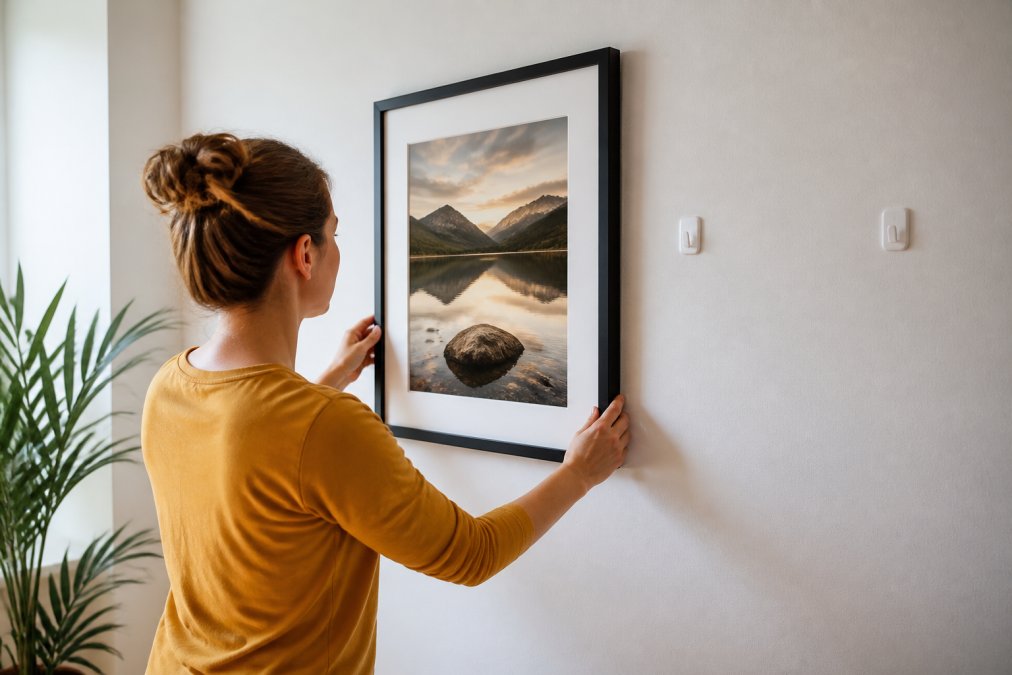
Ready-to-hang pieces (canvas gallery wraps, face-mounted acrylic, framed prints) cost more upfront but remove the framing step and the risk of a bad mat cut. Frame-it-yourself is cheaper if you already own a frame or buy a standard one, but you carry the mat, glazing, and backing decisions. For renters, removable adhesive strips and French cleats avoid nails; for heavy pieces over about 20 pounds, use wall anchors rated for the weight.
Hanging height and light
Hang the center of the piece at eye level, roughly 57 to 60 inches from the floor. Keep prints out of direct sunlight and away from heat sources; even archival pigment prints fade faster under sustained UV.
For a step-by-step on hardware and wall protection, see our guide on how to hang art without damaging walls.
Compare Your Options and Order Your Print
Here's the short version, sorted by what you're actually trying to do.
| Source | Best For | What You Get | Watch Out For |
|---|---|---|---|
| LarryCoulsonPhoto | Curated fine art | Landscape, cityscape, nature, travel, abstract | Smaller catalog |
| Fine Art America | Maximum choice | Print-on-demand formats | Inconsistent quality |
| Redbubble | Budget browsing | Wide product range | Variable sellers |
| Shutterfly | Personal photos | Custom prints and wall art | Consumer-grade paper |
| Amazon Prints | Volume snapshots | 4x6 prints at 17 cents | Not fine art |
| Printique | Self-printing | Lab prints from $0.32 | You supply the file |
| Nations Photo Lab | Self-printing | Professional lab prints | You supply the file |
| YellowKorner | Gallery-ready | Limited-edition travel and urban | Higher commitment |
Start with the wall, not the shop. Measure the space, decide the mood, then match the source to the job. When you want a curated collection of fine art photography prints with landscape, cityscape, nature, travel, and abstract work in one place, browse the LarryCoulsonPhoto collection and find the piece that fits your room.
Frequently Asked Questions
Where can I buy high-quality travel photography prints?
You can buy travel photography prints from several types of sources. Artist-run shops like LarryCoulsonPhoto offer curated fine art photography prints with a specific aesthetic. Marketplaces like Fine Art America and Redbubble connect you with many independent photographers. Professional photography print labs such as Printique and Nations Photo Lab are best if you already have a digital file and want it printed on archival paper. For limited-edition or gallery-ready pieces, specialty retailers like YellowKorner focus on contemporary travel and urban photography.
What is the difference between a poster and a fine art print?
A poster is typically printed on thinner, less expensive paper using standard inks, and it is meant for short-term display. A fine art print uses archival pigment inks and heavier cotton or rag paper designed to resist fading for decades. Fine art photography prints also usually come from a photographer's limited or signed editions, while posters are mass-produced. If you want a piece that holds its color and value over time, choose a fine art print over a poster.
How do I choose the right size for a photography print?
Measure the wall space first, then leave 2 to 4 inches of breathing room around the frame on each side. A common rule is that art should cover about 60 to 75 percent of the wall width above a sofa or console. For large-format photography prints, confirm the frame and mat will fit your ceiling height and doorway clearance. If you are unsure, order a smaller size or ask the seller for a wall mockup before committing.
Are fine art photography prints worth buying?
Fine art prints are worth it when you want lasting color, archival paper, and a connection to the photographer's work. They cost more than standard poster prints because of the materials and the artist's involvement. If you are decorating a rental on a tight budget, a standard print may be enough. If you are building a collection or gifting something meaningful, the longevity and authenticity of a fine art photography print usually justify the higher price.
Can I buy travel photography prints directly from photographers?
Yes. Many photographers sell directly through their own websites or artist shops, which often means signed prints, limited editions, and a direct line to the person who made the image. Buying direct also tends to put more of your money in the artist's hands. Check whether the listing states the edition size, paper type, and whether the print is signed. If those details are missing, ask before you buy.