 listicle
Best Ways to Gift Fine Art Photography in 2026
Last Updated: October 23, 2026
Quick Summary
The best ways to gift fine art photography are to match the print to the recipient's space, choose a size and medium that suit the wall, and decide between ready-to-hang and unframed. Add a handwritten note explaining why you chose the image, and ship it with a care card.
- Photograph the recipient's main wall on your phone before buying to judge light, color, and scale.
- When taste is unknown, give an unframed print plus a gift card for professional framing.
- Paper suits collectors, canvas suits relaxed rooms, and metal suits modern high-contrast interiors.
- Look for acid-free papers, pigment inks, and UV protection so the print lasts decades.
- Unframed paper prints under roughly 11x14 inches should ship flat between rigid boards.
Table of Contents
- Why Fine Art Photography Makes a Lasting Gift
- How to Choose Art for Someone Else Without Guessing
- Photo Print Sizes for Gifts: Getting the Scale Right
- Paper, Canvas, or Metal: Matching the Medium to the Room
- Framing Decisions: Ready-to-Hang vs. Unframed
- Creative Ways to Present a Photo Gift
- Personalized Photo Gifts and Notes That Add Meaning
- Shipping, Care, and What Happens After the Gift
- Frequently Asked Questions
Why Fine Art Photography Makes a Lasting Gift
Fine art photography is a printed image made to gallery standards, signed or editioned by the photographer, and built to last decades rather than seasons. That durability is why it works as a gift: it doesn't get used up, outgrown, or forgotten in a drawer.
People remember the print on the wall long after they've forgotten the scented candle. A framed photograph anchors a hallway, finishes an office, and gives a blank rental wall a reason to exist.
Unlike furniture or textiles, a print doesn't need to match a sofa, it needs to match a feeling. Below, we'll walk through gifting fine art photography, from reading someone's space to shipping a print so it arrives intact.
How to Choose Art for Someone Else Without Guessing
Choosing art for someone else comes down to observation, not mind-reading. Look for three signals: the colors already in the room, the scale of what's hanging there now, and the subject matter they gravitate toward.
Most gift buyers skip this step and shop by personal taste. That's the most common mistake we see. A striking desert landscape you love may clash with a recipient's cool-toned, minimalist apartment.
Reading Their Space and Style
Start with the room where the piece will live. Note the wall color, dominant furniture tones, and whether the decor leans warm or cool.
Then look at scale. A small print on a large empty wall looks lost; an oversized piece in a narrow hallway feels cramped. If they already have art, measure one piece and note its proportion to the wall.
When You Don't Know Their Taste
If you genuinely can't read their style, don't force a physical guess. The framing guidance from The Great Frame Up makes a sensible point: when taste is unknown, an unframed print paired with a gift card for professional framing is the safer route. The recipient picks the frame; you've still given real art.
Photo Print Sizes for Gifts: Getting the Scale Right
The right photo print size for a gift depends on the wall, not the budget. Start small to medium for a hallway, shelf, or desk-adjacent wall, and scale up for a sofa wall or open-plan space.
Here's a rough decision guide we use when helping buyers pick:
Wall or Space | Suggested Print Size | Why It Works |
|---|---|---|
Narrow hallway, small nook | Small framed print | Fits tight sightlines without crowding |
Desk, shelf, side table | Small to medium print | Reads well at close viewing distance |
Sofa or bed wall | Medium to large print | Holds its own against bulky furniture |
Large open wall | Large or oversized print | Prevents a "lost stamp" look |
Match the print's aspect ratio to the wall: a wide panorama suits a long horizontal wall, a vertical composition suits a tall, narrow space.
Paper, Canvas, or Metal: Matching the Medium to the Room
Paper suits collectors and detail-focused spaces, canvas suits relaxed and textured rooms, and metal suits modern, high-contrast interiors. The medium changes how the image reads as much as the subject does.
Fine art paper prints, often giclée on cotton rag, deliver the sharpest detail and truest color accuracy but need framing and glazing. Canvas wraps arrive ready-to-hang, and their texture softens an image, suiting rustic or coastal rooms. Metal prints bond the image to a rigid panel for a glossy, saturated look that holds up in bright, modern interiors.
Archival Standards That Protect Your Gift
Archival quality separates a print that lasts decades from one that fades in a few years. Look for acid-free papers and mats, pigment-based inks rather than dye, and UV protection in the glazing or coating, details that decide whether the gift still looks right in ten years.
Ask the seller directly what paper and ink they use. A photographer who can answer in specifics prints to a standard.
Framing Decisions: Ready-to-Hang vs. Unframed
Ready-to-hang prints remove every decision from the recipient, while unframed prints hand over creative control.
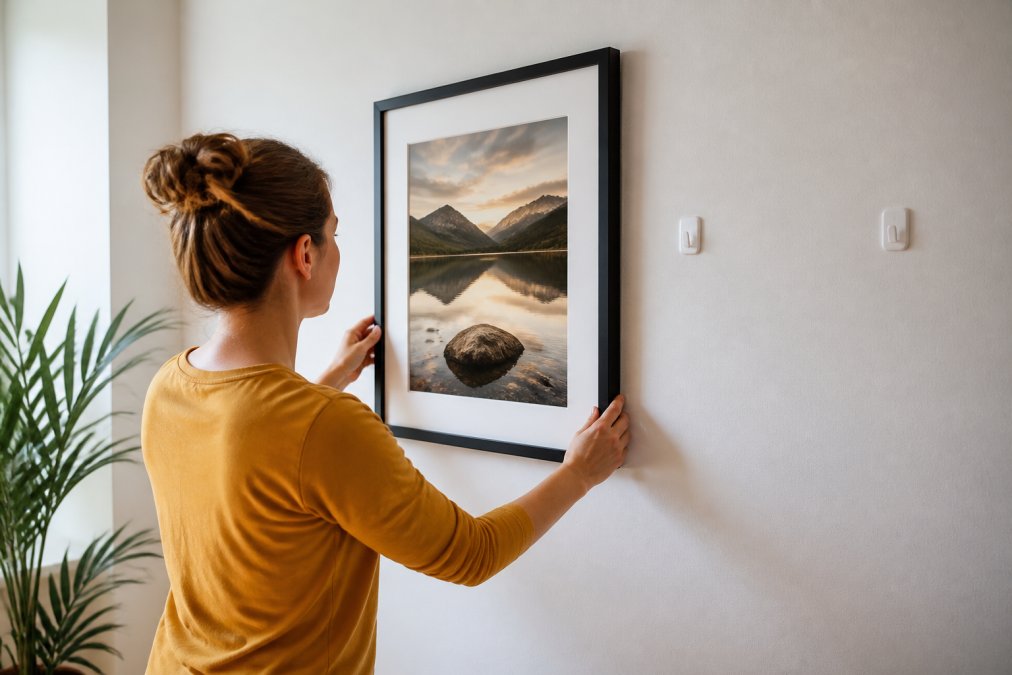
A ready-to-hang framed print is the safer gift for someone with a finished, settled home: it arrives with display hardware and can go on the wall the day it's opened.
Unframed prints suit renters and people who enjoy curating their own space. They're lighter to ship, easier to store, and leave room for the recipient to choose matting and museum glass later.
Creative Ways to Present a Photo Gift
Presentation turns a print into an occasion. The wrapping, the note, and the reveal matter as much as the image itself.

A few presentation ideas that work well:
- Wrap the framed print in kraft paper and tie it with ribbon, then tuck a handwritten note under the bow.
- Present an unframed print in a portfolio sleeve with a small card explaining the location and the photographer.
- Pair the print with a related small object, such as a postcard of the same scene, for a layered reveal.
The handwritten note is the detail recipients mention most. A sentence about why you chose that image carries more weight than any wrapping.
Personalized Photo Gifts and Notes That Add Meaning
Personalization turns a beautiful print into a gift that belongs to one person, from a handwritten note explaining the connection to printing your own photograph to archival standards as a signed, editioned piece. Most gifting guides only cover the first path; the second, the digital-to-physical workflow, is where a gift becomes genuinely one of a kind.
Gifting Your Own Photography: The Digital-to-Physical Workflow
If you have a photograph worth giving, a landscape from a shared trip, a portrait, a street scene, you can have it printed to fine art standards rather than ordering a consumer lab print. The workflow matters:
- Start with a high-resolution file. A print needs roughly 300 pixels per inch at its final size. An 8x10 inch print needs about 2400x3000 pixels; a 16x20 inch print needs about 4800x6000 pixels. Phone photos can work at small sizes but rarely hold up at 16x20 or larger. Check the file's pixel dimensions before choosing a size.
- Choose an archival paper. Cotton rag (often called fine art paper) and baryta papers are the common choices for photography. Ask the printer for acid-free, lignin-free stock. Hahnemühle Photo Rag and Canson Infinity Baryta are widely used examples; most fine art printers stock equivalents.
- Specify pigment inks, not dye. Pigment inks are the standard for archival fine art printing and resist fading far better than dye-based inks. Consumer photo labs often use dye; a fine art print shop will confirm pigment.
- Proof before the final print. Order a small proof print first, especially for color-critical images. Screens are bright and saturated; a proof shows what the paper and ink will actually do.
- Sign and edition. A pencil signature and edition number on the front border (or a signed certificate on the back) is what separates a fine art print from a poster. Keep editions small, 25, 50, or 100, and number them consistently (e.g., "3/50").
- Add a certificate of authenticity. A one-page certificate stating the title, year, paper, ink type, edition size, and your signature adds provenance and makes the gift feel like a collected work.
This path costs more than a consumer lab print but far less than an established photographer's work, and it produces a gift no one else can give.
Writing the Note That Carries the Meaning
A personalized note should answer one question: why this image, for this person? "This is the coastline from your trip last summer" does more than "I thought you'd like this." Name the place, the moment, or the shared memory.
If you're ordering from LarryCoulsonPhoto, our landscape, cityscape, nature, travel, and abstract collections give you room to match an image to a memory or a room's mood.
Shipping, Care, and What Happens After the Gift
Shipping logistics decide whether a gift arrives as art or as a damaged box, and post-gift care decides whether it still looks like art in ten years. Most guides stop at "pack it well." The useful version goes further: match the shipping method to the format, then hand the recipient a care card that protects an archival print the way a gallery would.
Shipping by Format
The right packaging depends on what you bought:
- Unframed paper prints should ship flat between two rigid boards (foam core or corrugated) in a crush-resistant box, or rolled in a rigid tube with the image facing inward and interleaving paper between the print and the tube wall. Flat shipping is safer for anything under roughly 11x14 inches; tubes are common for larger paper prints but require the recipient to flatten the print under weight for a day or two before framing.
- Canvas wraps need corner protectors, a foam or bubble wrap layer, and a box sized so the canvas cannot shift. Canvas dents permanently, so "snug" matters more than "padded."
- Metal prints are rigid but scratch-prone; a protective film or paper sleeve plus corner guards prevents surface scuffs in transit.
Ask the seller how they pack before you buy. A print shipped loose in a soft envelope is a red flag, and so is a framed piece with no corner protection. Reputable fine art shippers use rigid mailers, double boxes, and insurance, take the insurance if offered.
The Care Card: A Post-Gifting Standard Most Guides Skip
A short care card is the highest-value insert you can add to a fine art gift, and almost no gifting guide mentions it. It should cover four things:
- Light, keep the print out of direct sunlight and away from strong reflected glare. UV glazing slows fading but does not stop it; even archival prints fade under sustained direct sun.
- Climate, avoid hanging above radiators, near stoves, or in damp rooms such as bathrooms without ventilation. Rapid humidity swings cause paper to cockle and canvas to sag.
- Handling, handle paper prints by the edges only, with clean cotton or nitrile gloves if framing later. Oils from fingers permanently mark uncoated paper.
- Cleaning, dust frames with a dry microfiber cloth. Never spray cleaner onto the glazing; spray onto the cloth, and never spray directly on an unglazed canvas or metal print.
A simple template you can print on a 3x5 card:
This print is made with pigment inks on acid-free paper (or archival canvas). To keep it looking its best: hang away from direct sun and heat sources, dust the frame with a dry cloth, and avoid damp rooms. Handle the print by its edges if you reframe. Questions about the edition or paper? Contact [photographer].
That small instruction protects the gift for years and signals that the piece is fine art, not decor.
Frequently Asked Questions
How do you choose fine art photography as a gift?
Start with the recipient's existing space rather than your own taste. Note the colors, frame styles, and subjects already on their walls, then choose a fine art photography print that complements those cues. If you're unsure, pick a subject with broad appeal, such as a landscape or cityscape, and lean toward a neutral palette. A small framed print on museum-quality paper typically runs around $150, so it's worth confirming the style before spending. An unframed print paired with a framing gift card is a safe fallback when taste is a mystery.
What size photo print makes a good gift?
For a first gift, a small or medium print works best because it fits almost any wall without measuring. Photo print sizes for gifts usually land in the 8x10 to 16x20 inch range, which suits hallways, desks, and gallery walls alike. If you know the recipient's wall space, size up for a statement piece above a sofa or bed. Keep the aspect ratio in mind too: a panoramic landscape needs a wide wall, while a square or vertical image suits narrow spaces. When in doubt, smaller is safer than oversized.
Should you give framed or unframed photography?
Framed prints arrive ready-to-hang and feel like a complete gift, which makes them the stronger choice when you know the recipient's style. Unframed prints cost less and let the recipient choose custom framing that matches their home, which is safer when taste is uncertain. A practical middle ground is an unframed print paired with a gift card for professional framing. Either way, confirm the print uses archival quality materials and acid-free matting so the piece holds up over time.
How can you make a photo gift feel more personal?
Personalized photo gifts work best when the image connects to a shared memory or a place the recipient loves. Choose a print of a location they've visited, a landscape that matches their travels, or a subject tied to a milestone. Add a handwritten note explaining why you picked that image, and mention the photographer or the story behind the shot. Limited edition prints with a numbered certificate add exclusivity. Small touches like custom gift wrapping and a card that names the specific memory turn a nice print into a keepsake.
Is a photography print a good housewarming gift?
Yes, a fine art photography print is one of the more useful housewarming gifts because it helps fill bare walls without adding clutter. Choose a subject that suits the home's character, such as a landscape for a place with natural light or a cityscape for an urban apartment. Keep the size modest unless you know the wall dimensions, and lean toward neutral tones that won't clash with furniture. Pair it with a personalized note about the new home, and consider a ready-to-hang framed option so they can display it immediately.
Gifting art still involves a leap of faith, especially when you can't see the recipient's walls. LarryCoulsonPhoto takes some of that guesswork out by offering a curated range of landscape, cityscape, nature, travel, and abstract prints, so you can match an image to a memory or a mood. Browse the collection, check current sizes and framing options on our site, and choose a piece that will still be on the wall years from now.