 listicle
Buy Large Scale Nature Photography Prints: 2026 Guide
Table of Contents
- Why Large Scale Nature Photography Prints Transform a Space
- Large Format Nature Photography Prints: Mediums That Define the Look
- Fine Art Nature Photography Prints: Limited Edition vs Open Edition
- How to Choose Photography Print Size for Your Wall
- Interior Design Integration: Matching Nature Prints to Your Room
- Lighting, Framing, and Long-Term Care for Large Prints
- Pricing and Where to Buy Large Scale Nature Photography Prints
- Frequently Asked Questions
Last Updated: October 7, 2026
Why Large Scale Nature Photography Prints Transform a Space
A single oversized print changes how a room feels before anyone says a word. When you buy large scale nature photography prints, you set the room's emotional temperature, not just fill wall space.
Scale is the reason. A small framed photo reads as decoration; a large format print reads as a window. The bigger the piece, the more the eye treats it as architecture, and the more its colors shape the mood.
Large Format Nature Photography Prints: Mediums That Define the Look
The print medium decides how your image looks, feels, and ages. Three options dominate large format nature photography prints: gallery-wrapped canvas, acrylic facemount, and aluminum metal.
Medium | Look and Feel | Best For | Watch Out For |
|---|---|---|---|
Gallery-wrapped canvas | Soft texture, matte finish, frameless | Warm, traditional, cozy rooms | Less crisp detail than rigid surfaces |
Acrylic facemount | Glossy depth, vivid color, glass-like shine | Modern statement pieces | Reflections in bright rooms |
Aluminum metal | Sleek, luminous, contemporary | Offices, minimalist interiors | Cooler color rendering |
Gallery-Wrapped Canvas
Gallery-wrapped canvas is the most forgiving medium for large-scale display. The image wraps around a wooden stretcher frame and arrives ready to hang, no framing required.
The woven texture softens detail slightly, suiting misty forests, soft seascapes, and warm landscape photography, and blends into rooms with natural fabrics and wood tones. A common mistake is hanging canvas in harsh direct sun, where the matte surface can fade without UV protection.
Acrylic Facemount and Aluminum Metal Prints
Acrylic facemount prints are the choice when color accuracy and depth matter most. The photograph is mounted behind acrylic, adding a glossy, almost three-dimensional quality that makes vibrant sunset or mountain seascape colors richer than on any other surface.
Aluminum metal prints take a different route. Dyes fuse into the metal, producing a sleek, luminous finish that resists moisture and glare better than acrylic, suiting modern architectural wall art and contemporary offices.
Fine Art Nature Photography Prints: Limited Edition vs Open Edition
Limited edition means the photographer caps how many copies will ever exist, each numbered and signed.
For collectors, limited edition fine art nature photography prints carry real weight.
Open edition prints win on flexibility: order the exact size your wall needs, replace a damaged print, and build a matched set across rooms.
Neither choice is wrong.
How to Choose Photography Print Size for Your Wall
Choosing photography print size comes down to two numbers: the wall space you have and the distance people will stand from the print. Get both right and the piece looks intentional. Get either wrong and it looks like a poster.
Measuring Your Space and Aspect Ratio
Measure the wall, then plan to fill roughly two-thirds to three-quarters of the available width with art.
Aspect ratio matters just as much. Horizontal suits wide walls, above sofas, and behind beds; vertical suits narrow walls, stairwells, and tall entryways.
Leave at least 8 to 10 inches of breathing room between the print and furniture below it.
Resolution and Viewing Distance
High-resolution capture separates a sharp large format print from a blurry one.
Viewing distance is the practical test: a print viewed from 10 feet can be far larger than one viewed from 3 feet in a hallway.
Ask about the source resolution before you buy anything oversized. A photographer who captures for large format printing will say so plainly.
Interior Design Integration: Matching Nature Prints to Your Room
Most buying guides stop at the image, but the piece only works once it is styled into a room. Here is how large-scale nature prints behave in the four room types buyers ask about most.
Living Rooms: Anchor the Seating, Not the Wall
In a living room, center the art over the sofa or sectional, not the wall's midpoint.
For a minimalist living room, a single oversized aluminum metal seascape in cool blues and grays reads as architecture. For a rustic room, a gallery-wrapped canvas of a misty forest or warm golden-hour landscape softens reclaimed wood and stone.
Bedrooms: Keep the Palette Quiet
Bedrooms reward restraint. A large print above the headboard should sit in the room's existing palette rather than introduce a new one.
Size the print to the bed, not the wall: a queen bed (60 inches wide) pairs with a 40- to 54-inch horizontal print, and a king (76 inches wide) with 54 to 66 inches.
Dining Rooms and Entryways: Go Bigger Than Feels Safe
Dining rooms and entryways are where buyers most often undersize. A table seating six to eight spans roughly 72 to 96 inches, and a print 60 to 72 inches wide holds the wall without floating. Entryways with tall ceilings can take a vertical piece, a towering mountain or slot-canyon composition, that uses height a horizontal print cannot.
Home Offices and Commercial Spaces: Match the Light and the Mood
Home offices and reception areas usually have brighter, more direct light than living spaces, making aluminum metal the practical default: a luminous metal landscape resists glare and holds color in a bright lobby.
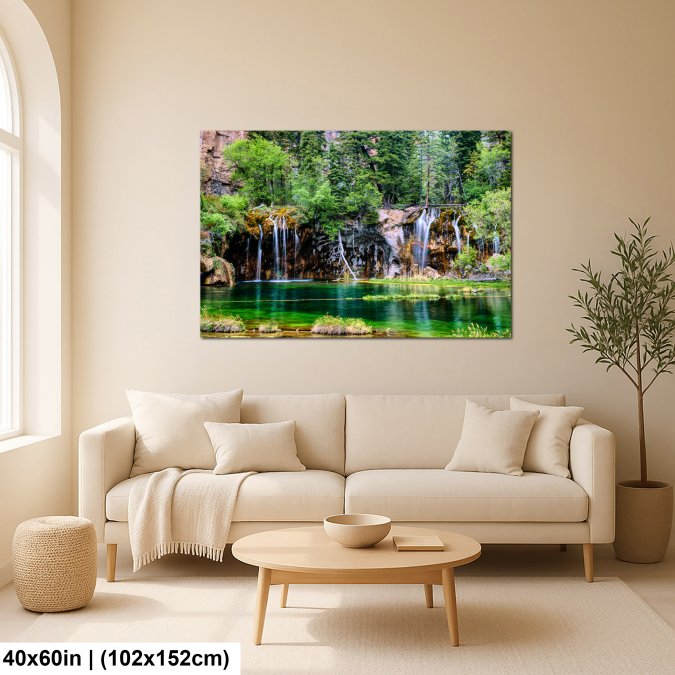
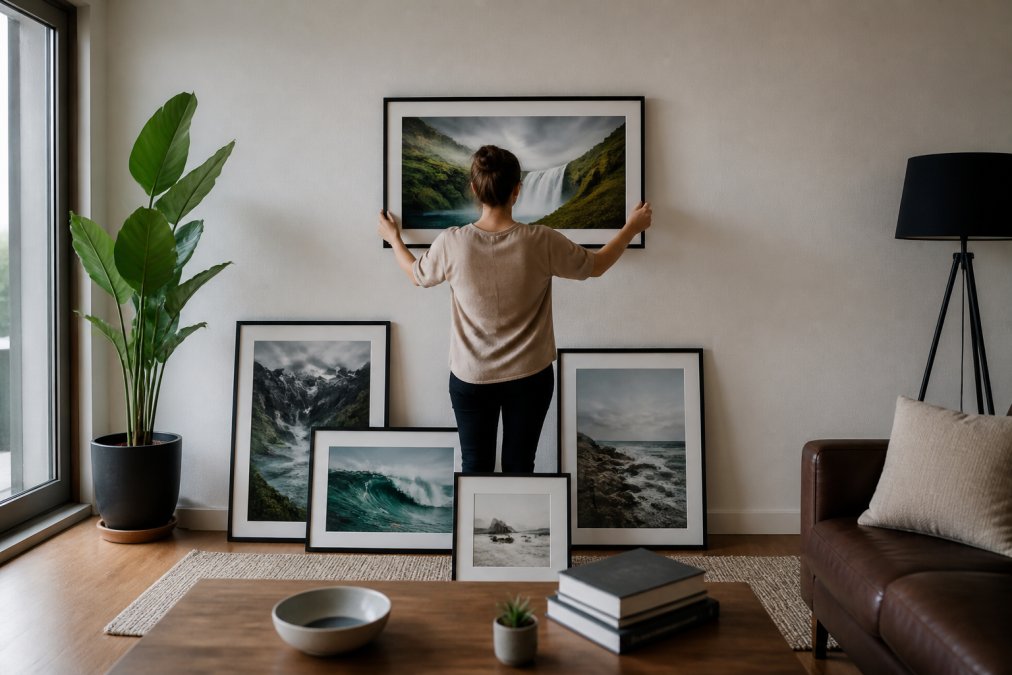
A large gallery-wrapped canvas print of a mountain landscape hanging above a mid-century modern sofa in a sunlit living room, with a person adjusting the frame
A Quick Room-by-Room Reference
Room | Typical Print Width | Best Medium | Palette Direction |
|---|---|---|---|
Living room (84" sofa) | 48-60" | Canvas or metal | Echo the room, or one cool accent |
Bedroom (queen bed) | 40-54" | Canvas | Low-contrast, cool |
Dining room (6-8 seats) | 60-72" | Acrylic or metal | Warm or neutral |
Entryway (tall ceiling) | Vertical, 40-48" wide | Metal | High-contrast |
Home office / lobby | 48-60" | Aluminum metal | Cool, luminous |
One more consideration for renters: removable adhesive mounts and lightweight canvas prints let you hang large art without drilling holes. Ask about weight before you commit, a 60-inch acrylic facemount can weigh substantially more than the same-size canvas, and the hardware has to match.
Lighting, Framing, and Long-Term Care for Large Prints
A large print is an investment in a surface looked at for years. How you light and clean it determines whether it still looks new in a decade, the part most sellers skip.
Lighting Large Art Without Glare
Glare is the enemy of any glossy surface.
A common pattern is to place lights at roughly 30 degrees off the wall plane, aimed down and across the surface rather than straight at it.
Color temperature matters too. Warm light (around 2700-3000K) flatters warm-toned landscapes and canvas. Cool light (around 4000K) suits cool seascapes and metal prints.
Framing Choices That Change the Character
Canvas and metal prints usually arrive ready to hang with no frame, keeping the focus on the image. If you do frame, width and tone shift the piece's personality:
- A thin dark frame (roughly 0.75 to 1 inch) reads modern and lets a landscape feel contemporary.
- A wide natural-wood frame (2 inches or more) warms a print and suits traditional or rustic rooms.
- A floater frame, a thin gap between the canvas edge and the frame, gives a gallery-wrapped canvas a finished, elevated look without hiding the wrapped edge.
For framed paper prints, ask for UV-filtering glazing. Standard glass blocks some UV; museum glass blocks more and cuts glare, at a higher cost.
Cleaning Acrylic vs. Canvas vs. Metal
The cleaning method depends on the surface, and using the wrong one can permanently damage a print.
- Acrylic facemount: Dust with a dry, soft microfiber cloth. For smudges, use a plastic-safe acrylic cleaner sprayed onto the cloth, never directly on the surface, and wipe gently. Avoid paper towels and ammonia-based glass cleaners, which can scratch or cloud acrylic.
- Gallery-wrapped canvas: Dust with a dry, soft brush or microfiber cloth. Never use a damp cloth; moisture can seep into the weave and cause the canvas to sag or the ink to bleed. Do not press hard, the surface is textured and can be dented.
- Aluminum metal: The most durable surface. Wipe with a damp microfiber cloth and a mild, non-abrasive soap if needed. Avoid solvents and abrasive pads, which can dull the finish.
Longevity: What Actually Fades a Print
UV exposure is the single biggest factor in how long a print keeps its color, and the larger the surface, the more total light it absorbs.
Humidity is the second factor. Canvas is most vulnerable to moisture swings, which is why bathrooms and unconditioned garages are poor rooms for it; metal and acrylic handle humidity far better.
Care is simple once you know the surface. Match the cloth to the medium, keep direct sun off the piece, and a well-made large print will hold its color for decades.
Pricing and Where to Buy Large Scale Nature Photography Prints
Pricing for large scale nature photography prints depends on the medium, the dimensions, and whether the edition is limited or open.
Here is how the trade-offs usually break down:
- Canvas, open edition: the most accessible entry point, especially at mid sizes
- Acrylic facemount: costs more because of the mounting process and finish quality
- Aluminum metal: priced between canvas and acrylic at most sizes
Where you buy matters as much as what you buy. Marketplace sites aggregate many artists but often add gallery markups.
This is where LarryCoulsonPhoto fits. Our curated collection spans landscape, cityscape, nature, travel, and abstract imagery, produced to museum-quality standards and available in the sizes large walls demand.
Frequently Asked Questions
Where can I buy large-scale nature photography prints?
You can buy large scale nature photography prints directly from artist studios like LarryCoulsonPhoto, which offers a curated collection of landscape, cityscape, and nature imagery. Artist-run shops often provide more transparency about print materials and limited editions than mass marketplaces. Look for galleries that specify archival inks, UV protection, and substrate options such as canvas, acrylic, or metal. Always check customer reviews and return policies before purchasing.
What size should a large nature photography print be?
The right size depends on your wall and viewing distance. A common rule is that the print should occupy 60 to 75 percent of the available wall width above a piece of furniture. For a sofa, a print 40 to 60 inches wide often works well. For a large empty wall, consider 60 inches or more. LarryCoulsonPhoto offers various sizes, and you can request custom dimensions to fit your exact space.
What is the best material for large photography prints?
Acrylic facemount prints offer vibrant colors and a modern look, while aluminum metal prints are durable and resist fading. Gallery-wrapped canvas provides a classic, textured appearance and is lighter for hanging. Each medium has trade-offs in cost, weight, and maintenance. For high-traffic areas or rooms with strong light, acrylic or metal with UV protection is often preferred. Canvas works well in traditional interiors.
Are large-format photography prints worth the price?
Large-format prints from fine art photographers are worth it if you value archival quality, limited editions, and a statement piece that lasts decades. Unlike cheap poster prints, they use museum-grade materials and are often signed. Pricing depends on size, medium, and edition size. LarryCoulsonPhoto provides detailed product information and you can contact them for current pricing and availability.
How can I tell if a fine art photography print is high quality?
Look for details like archival pigment inks, acid-free papers, and UV-protective coatings. Limited edition prints should come with a certificate of authenticity and be numbered. The photographer's reputation and customer reviews also matter. LarryCoulsonPhoto holds a 5-star aggregate rating, and their prints are designed for longevity. Ask about the printing process and materials before you buy.
A large blank wall is an opportunity, but choosing the wrong print, size, or medium turns that opportunity into an expensive mistake. LarryCoulsonPhoto removes the guesswork with a curated range of fine art nature photography prints, museum-quality production standards, and a variety of mediums and subjects to suit any interior. Get started with LarryCoulsonPhoto and turn your empty wall into the calmest, most striking part of the room.