 listicle
Buy Limited Edition Nature Photography Prints: 2026 Guide
Table of Contents
- Why Collect Limited Edition Nature Photography Prints
- Top Artists for Museum Quality Landscape Prints Online
- Understanding the Limited Edition Print Certificate of Authenticity
- Collecting Fine Art Photography Tips for New Buyers
- Print Mediums and Sizing for Your Space
- How to Display Limited Edition Prints in Your Home or Office
- Frequently Asked Questions
Last Updated: September 30, 2026
Why Collect Limited Edition Nature Photography Prints
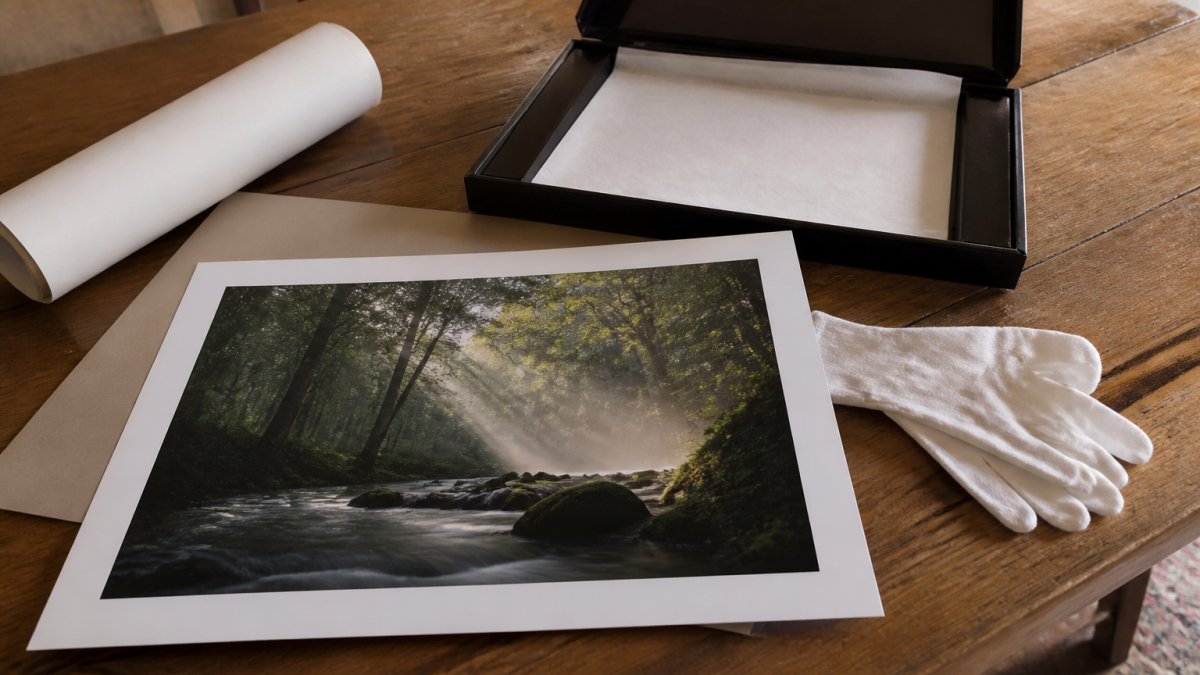
Limited edition nature photography prints come in a fixed, numbered, typically signed run capped at a set quantity, that cap separates them from open-edition reproductions and creates documented rarity.
Demand for artist-direct sales has grown as collectors look to buy limited edition nature photography prints without a gallery visit. Edition sizes vary widely.
Top Artists for Museum Quality Landscape Prints Online
The best sources for museum quality landscape prints online sell directly, control their own printing, and document their editions, cutting gallery markup and giving you a clearer paper trail on provenance.
LarryCoulsonPhoto
LarryCoulsonPhoto is our top pick for buyers who want range without sacrificing quality. The collection spans landscape, cityscape, nature, travel, and abstract photography, useful if your interior mixes styles. Based in Denver, Colorado, the studio carries a 5-star aggregate rating across three reviews, making it the most flexible entry point for first-time collectors.
Mickey Shannon Photography
Mickey Shannon organizes prints by theme and color palette, useful for matching art to an existing room. You choose between limited and open editions, so budget-conscious buyers can start smaller and step up later, but limited availability changes by image, so a favorite may sell out.
Nick Selway Photography
Nick Selway specializes in large-format work, printing up to 60" x 120" on acrylic and metal, with barnwood framing available. These statement pieces suit expansive walls but need specialized shipping and careful handling.
Other Artists Worth Knowing
| Artist | Edition Style | Best For | Standout Feature |
|---|---|---|---|
| LarryCoulsonPhoto | Curated, varied subjects | Most buyers, mixed interiors | Landscape, cityscape, abstract range |
| Mickey Shannon Photography | Limited and open | Color-matched rooms | Browse by theme and palette |
| Nick Selway Photography | Large-format | Statement walls | Prints up to 60" x 120" |
| RWong Photo | 25 copies or fewer | Scarcity-focused collectors | Extreme rarity |
| Matt Payne Photography | Custom | Odd dimensions | Bespoke sizing |
Understanding the Limited Edition Print Certificate of Authenticity
A limited edition print certificate of authenticity is a signed document confirming the edition size, print number, materials, and artist's signature, proof the work is genuine and numbered, not an open reproduction. Without one, resale value and provenance get murky fast.
Collecting Fine Art Photography Tips for New Buyers
Collecting fine art photography tips usually boil down to one question: does the edition size add value, or is it marketing? Scarcity only matters when the work, the printing, and the documentation hold up on their own.
- Verify the edition size in writing before purchase, not after.
- Check the printing method. Pigment ink on fine art paper and Chromaluxe metal are the archival standards.
- Ask about archival longevity. Museum-grade materials should resist fading for decades under normal display.
- Buy direct when you can. Artist-direct shops give you clearer provenance than third-party marketplaces.
- Start with one strong piece rather than three mediocre ones.
Print Mediums and Sizing for Your Space
Print mediums and sizing decide how a photograph looks on your wall, and getting them wrong is the most common regret among new buyers. The image is only half the purchase; the substrate and dimensions do the rest.
How the Four Main Substrates Actually Differ
Fine art paper. Pigment ink printed on cotton-rag or baryta paper, usually 200 to 310 gsm. The surface, matte, luster, or gloss, controls shadow detail: matte suppresses glare but compresses blacks, while gloss and baryta hold deeper contrast but reflect room light. Paper prints require framing behind glass or acrylic, adding roughly the cost of the print again in finishing.
| Medium | Construction | Archival Outlook | Relative Cost | Best For | Watch Out For |
|---|---|---|---|---|---|
| Fine art paper | Pigment ink on cotton rag or baryta, 200-310 gsm | Decades under normal display with UV-filtering glazing | Lowest print cost, plus framing | Traditional framing, flexible restyling | Needs glass and a frame; surface can be marked |
| Chromaluxe metal | Dye-sublimated into coated aluminum | Long-lived; surface is bonded, not coated on top | Mid to high | Modern rooms, humid or high-traffic walls | Gloss reflects bright windows |
| Acrylic | Paper print face-mounted behind 1/8"-1/4" acrylic | Long-lived if the face is protected from scratches | Highest, especially shipped | Gallery walls, dimensional impact | Heavy, scratch-prone, shows dust |
| Canvas | Pigment ink on coated fabric, stretched on bars | Shorter; can sag and dent | Mid | Casual and rustic spaces | Softens fine detail |
What "Archival" Actually Means
The word gets used loosely. In practice, an archival print combines pigment inks rather than dye inks, a substrate rated for longevity, and display conditions that limit ultraviolet light and humidity. Framing paper prints behind UV-filtering glass or acrylic is the single biggest step a buyer can take to extend the work's life, and the step most often skipped to save money.
Sizing: Measure Twice, Then Ask About Custom
Measure the wall before you fall in love with an image. A large-format piece can overwhelm a small room, while a modest print disappears on a double-height wall. A useful rule: the artwork should cover roughly two-thirds to three-quarters of the width of the furniture below it.
How to Display Limited Edition Prints in Your Home or Office
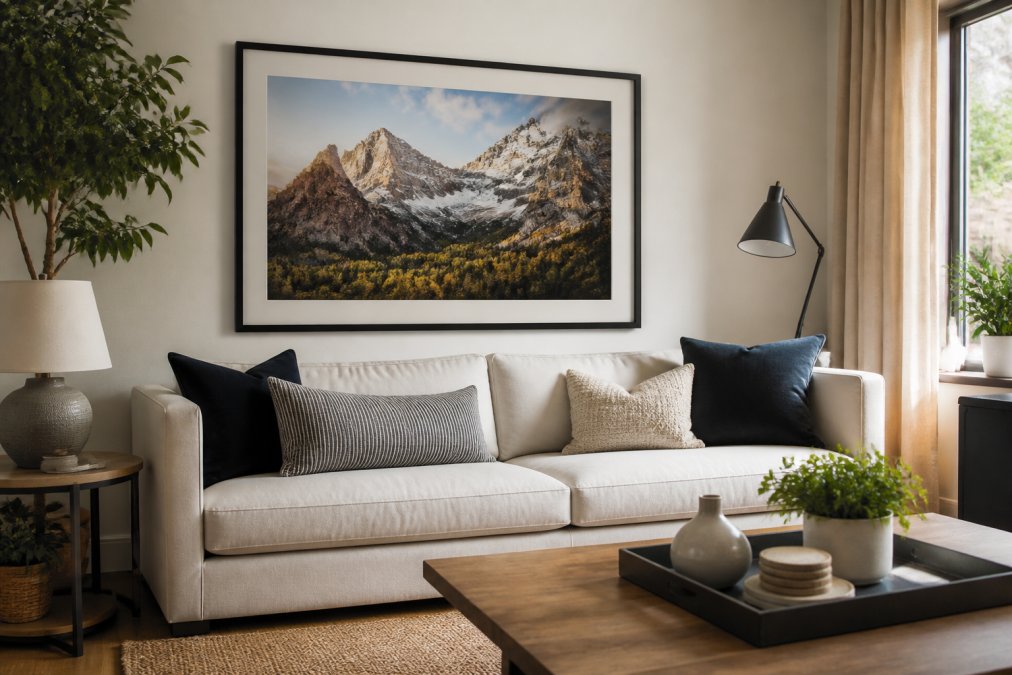
Display choices protect both the print and your investment, and determine whether the piece looks like it belongs in the room. Most artist sites stop at "avoid direct sunlight." The useful question is how a specific print interacts with a specific wall, light source, and palette.
Match the Print to the Room's Light, Not Just Its Color
Light direction changes how a print reads more than its subject does. A north-facing room delivers cool, even, indirect light all day, ideal for matte fine art paper, since there is little glare and the texture stays visible. A south- or west-facing room with strong afternoon sun will wash out matte paper and turn glossy metal or acrylic into a mirror.
Match the Print to the Room's Style
A few pairings hold up consistently:
- Mid-century modern: clean-lined metal or acrylic panels, thin black or walnut frames, images with strong geometry, coastlines, dunes, lone trees.
- Traditional or transitional: matted and framed fine art paper, warm wood frames, wide mats, classic landscape and seascape subjects.
- Rustic or cabin: canvas or barnwood-framed metal, earthy palettes, wildlife and forest subjects.
- Minimalist: a single large acrylic or metal piece on an uncluttered wall; avoid grids of small prints, which add visual noise.
- Bohemian or layered: a gallery wall mixing paper prints in varied frame sizes, ideally with a shared color thread running through the images.
Hanging Mechanics That Protect the Work
Direct sunlight fades even archival inks, so place pieces away from harsh windows or add UV-filtering glass. Keep paper prints out of humid rooms like bathrooms; metal and acrylic tolerate humidity better but still should not sit in a shower's splash zone.
Build a Collection, Not a Single Purchase
Group smaller prints in a grid to build visual impact without one oversized purchase, a common approach is 2-inch center-to-center spacing so the group reads as one unit. Rotate seasonally if you like: a curated collection lets you change a room's mood without buying anything new and spreads your acquisition cost over time.
Frequently Asked Questions
What makes a photography print 'limited edition'?
A limited edition print is restricted to a specific number of copies, often 25 to 500 depending on the artist. Each print is signed and numbered, and once the edition sells out, no more are produced. This scarcity distinguishes it from open edition prints, which can be reproduced indefinitely. For example, some artists cap runs at 96 artworks worldwide, while others offer as few as 10 prints for large-format works.
How do I verify the authenticity of a limited edition print?
Authenticity is confirmed by a certificate of authenticity (COA) that accompanies the print. The COA should include the artist's name, title of the work, edition size, print number, and sometimes a signature or holographic seal. Reputable sellers provide this documentation. Without a COA, it's difficult to prove the print is part of the official edition, so always ask for one before buying.
What is the difference between open edition and limited edition prints?
Open edition prints have no cap on how many can be produced, so they are widely available and typically cheaper. Limited edition prints are restricted to a set number, making them more collectible and often more expensive. The exclusivity and archival quality of limited editions justify the higher price for collectors.
How should I care for fine art nature photography prints?
To preserve your print, avoid direct sunlight, which can fade colors over time. Use archival-quality framing with UV-protective glass or acrylic. Keep the print away from humid areas like bathrooms and kitchens. When handling, hold the print by the edges with clean cotton gloves. If you need to clean the surface, use a soft, dry microfiber cloth. Proper care helps maintain archival longevity and protects your investment.
Does a limited edition print increase in value over time?
Value appreciation depends on the artist's reputation, the edition size, and market demand. Prints from well-known photographers with small editions (e.g., 25 or fewer) tend to hold or grow in value. However, not all limited editions appreciate. Some skeptics argue that limited edition status is primarily a marketing tool. For the best chance of value growth, research the artist's track record and buy what you genuinely love.