 how-to
7 Smart Ways to Choose Art for Small Spaces
Last Updated: November 4, 2026
Quick Summary
Choose small spaces art by sizing each piece to span 60-75% of the furniture below it, then hang the center at 57 to 60 inches from the floor. Keep one dominant piece rather than several competing ones, and leave 6 to 10 inches between the art and the furniture.
- Measure the wall and the furniture below it before you browse for art.
- A 72-inch sofa calls for a piece around 48 inches wide.
- Hang the bottom edge 6 to 8 inches above the sofa back.
- A gallery wall works only with three to five pieces and tight spacing.
- If the frame costs more than the print, you are over-framing.
Table of Contents
- Why Scale and Proportion Decide Everything in Small Spaces
- How to Choose Art for Small Spaces for Living Room Walls
- How to Display Artwork on Wall: Measuring, Height, and Hanging
- Unexpected Places to Hang Art in Tight Rooms
- How to Tell If You Have Too Much Art on Walls
- Rental-Friendly Hanging, Lighting, and Budget Framing
- Pick Your Print and Plan the Hang
- Frequently Asked Questions
Why Scale and Proportion Decide Everything in Small Spaces
A print that spans 60-75% of the furniture below it reads as intentional. A postcard-sized frame floating on a wide blank wall reads as a mistake.
Scale is the relationship between artwork size and the wall, furniture, and room around it. Proportion is how those pieces balance each other. Get both right and a compact living room feels curated.
Buyers often fall in love with an image, then order it too small for the wall it was meant for. For broader guidance on choosing wall art for modern apartments, start with the room's layout before you shop.
A few rules hold up in almost every tight room:
- Measure the wall and the furniture below it before you browse
- Treat empty wall space as a design element, not a gap to fill
- Match orientation to the wall's shape: vertical art for tall, narrow walls
How to Choose Art for Small Spaces for Living Room Walls
Start with the largest wall in the room. That is where a single strong piece earns its space. Knowing how to choose art for small spaces for living room walls comes down to three numbers: wall width, sofa width, and viewing distance.
Sizing a Statement Piece Above the Sofa
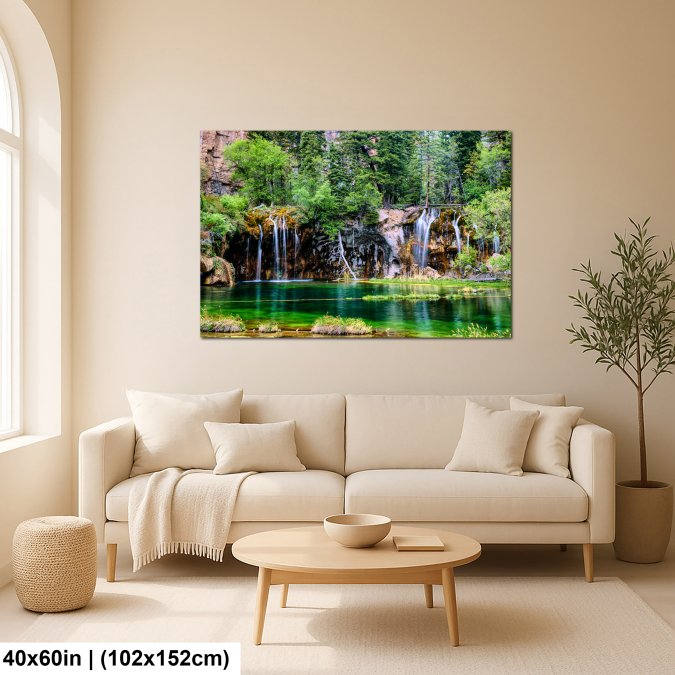
Measure your sofa's width. Your art should span roughly two-thirds of it. A 72-inch sofa calls for a piece around 48 inches wide. Leave 6 to 10 inches of breathing room between the art and the sofa back.
Hang it so the bottom edge sits 6 to 8 inches above the sofa. That keeps the art connected to the furniture instead of floating toward the ceiling.
Single Piece vs. Gallery Wall in a Compact Living Room
One large print almost always wins in a small living room. It creates a clear focal point and reduces visual clutter. A gallery wall can work, but only with restraint: three to five pieces, tight spacing, and a shared color story.
If you lean toward a group, plan the layout carefully before you commit. Our guide to curating a gallery wall walks through arranging the pieces.
Room Situation | Best Choice | Why |
|---|---|---|
Wide wall above a sofa | Single large piece | One clear focal point |
Narrow wall beside a door | Vertical piece | Draws the eye upward |
Long hallway | Pair or triptych | Fills length without clutter |
Rental with no nails | Leaning or shelf display | No wall damage |
How to Display Artwork on Wall: Measuring, Height, and Hanging
The center of your art should sit at eye level, roughly 57 to 60 inches from the floor. That is the standard galleries use, and it works in small rooms too. But eye level is only the last step.

The woman is American.
The Five-Measurement Sequence
Work through these in order and write each number down. Guessing any one of them is where most small-space hangs go wrong.
- Available wall width. Measure the clear wall span you are decorating, edge to edge, not the whole room. A wall broken by a door, a window, or a closet is several smaller walls, and each one gets its own measurement.
- Furniture width. Measure the sofa, console, dresser, or bed the art will sit above. If there is no furniture, measure the wall span and treat that as your anchor.
- Art width target. Multiply the furniture width by 0.60 to 0.75. A 72-inch sofa gives a target range of about 43 to 54 inches of art width. A 36-inch console gives about 22 to 27 inches. If the wall itself is narrower than the furniture, use the wall width instead and aim for 50 to 75% of it.
- Vertical gap. Measure from the top of the furniture to the bottom edge of the frame. Six to 10 inches keeps the art visually connected to the furniture. Less than 6 inches feels cramped; more than 10 inches and the art starts to float.
- Center height. Measure from the floor to the center of the frame. Aim for 57 to 60 inches. In a room where people mostly sit, such as a small living room or dining nook, 57 inches reads better. In an entry or hallway where people stand, 60 inches is the safer target.
Worked Examples for Common Small-Space Setups
- Above a 72-inch sofa: target art width 43 to 54 inches. A single 48-inch-wide framed print leaves roughly 12 inches of wall on each side. Bottom edge 6 to 8 inches above the sofa back.
- Above a 36-inch entry console: target art width 22 to 27 inches. A 24-inch-wide vertical piece centered on the console works, with the bottom edge about 6 inches above the console top.
- Above a 60-inch bed in a small bedroom: target art width 36 to 45 inches. A single horizontal piece or a tight pair totaling that width. Bottom edge 6 to 10 inches above the headboard.
Hanging Height and Hardware Math
Once you know the center height, find the nail or hook position rather than eyeballing it.
For a 24-inch-tall frame with the wire sitting 3 inches below the top, the top-to-hook distance is 12 plus 3, or 15 inches. With a 57-inch center height, the hook goes at 57 minus 15, or 42 inches from the floor.
Two hooks set 2 to 4 inches apart, each about one-third of the frame width in from the sides, keep a wide frame level. A single hook lets a wide frame drift. For a pair or a row, keep the gaps between frames consistent, usually 2 to 3 inches in a compact room, and measure the gap rather than the frame edges so the spacing stays even.
Watch out: hanging a heavy frame on a single drywall anchor in a narrow wall segment can pull loose, so check the anchor rating against the frame weight before you commit.
If you want to avoid nails entirely, several damage-free alternatives exist. See our guide to hanging art without damaging walls for the practical methods.
Unexpected Places to Hang Art in Tight Rooms
Small homes have more usable wall space than owners realize. Look beyond the obvious sofa wall.
- Inside a bookcase: lean a small framed print against the back panel
- Above a doorway: a horizontal piece uses dead space
- Beside a window: a narrow vertical print fills the gap
These spots add personality without crowding your main walls. Just keep each piece small and let the surrounding space stay quiet.
How to Tell If You Have Too Much Art on Walls
Too much art on walls shows up as visual noise. You feel it before you can name it: the room feels busy, and no single piece stands out.
Run this quick check:
- Can you name the focal point of the room in one second?
- Is there at least one blank wall or open stretch of wall?
- Do the frames share a color or finish?
If you answer no to two or more, pull a piece down. Negative space is what makes the remaining art look deliberate. Store extras and rotate them seasonally.
Rental-Friendly Hanging, Lighting, and Budget Framing
Three constraints decide how art actually lives in a small home: whether you can put holes in the wall, how the light hits the piece, and what you can spend on framing. Most guides skip at least one. Here is how to handle all three without turning the room into a hardware project.
Rental-Friendly Display Methods
Renters and anyone who cannot drill have more options than adhesive strips alone. For nature photography without frames, there are display options built for tight, temporary spaces.
- Removable adhesive strips: best for lightweight frames, roughly under 5 pounds, on smooth painted drywall. Clean the wall with rubbing alcohol and let it dry before applying. Follow the strip maker's weight rating and use more strips than the minimum for anything near the limit.
- Picture ledges: a shallow shelf holds several frames and needs only two anchored screws, so the damage is minimal and the display is easy to rearrange. Good for narrow walls and above a desk or console.
- Leaning: a large frame on a mantel, a deep shelf, or the floor against a wall needs no hardware at all. In a small room, a leaning piece reads as intentional and can be swapped seasonally.
Watch out: adhesive strips can pull paint or drywall paper when removed, especially on fresh or glossy paint; test one strip in a hidden spot first, and remove strips slowly while pulling the tab parallel to the wall.
Lighting, Glare, and Viewing Angle
Light decides whether a print reads as rich or washed out. In a compact room the same window that makes the space feel bigger can also put a hot reflection across the glass.
- Keep art off direct sun. Direct sun fades prints and pushes glare. Side walls and interior walls are safer than the wall facing a bright window.
- Check the glare from where you sit. Sit in your usual chair and look at the art. If you see a bright reflection of a window or lamp, move the piece or shift the light source.
- Use a small picture light or nearby lamp to light the art rather than the whole wall. A picture light mounted on the frame top throws light down the image and keeps the rest of the room dim, which suits small spaces.
Budget Framing Decisions
Spend on the print and keep the frame simple. In a small room, thin metal or wood frames cost less and suit modern interiors better than wide ornate moldings, which can overwhelm a compact wall.
- Prioritize print size over frame finish. The right size matters more than the molding. A correctly sized print in a basic frame beats an undersized print in an expensive one.
- Standard sizes cost less. Frames in common sizes are cheaper and easier to replace than custom cuts.
- Skip glass where it is safe to do so. A print mounted on a rigid board or displayed frameless avoids glazing cost and glare at once.
A simple rule: if the frame costs more than the print, you are probably over-framing for a small space.
Pick Your Print and Plan the Hang
The best small-space art does two jobs: it fits the wall, and it fits the mood of the room. A serene landscape or a quiet cityscape can make a compact room feel larger and calmer. A bold abstract can give a plain wall energy.
Before you buy, preview the piece in your space, so you order the right size the first time.
Here is how we would plan it:
- Measure the wall and the furniture below it
- Pick the size using the 60-75% rule
- Choose one focal piece, not five
- Preview it on your wall
- Hang at eye level and step back
Frequently Asked Questions
How do I choose the right size art for a small room?
Measure the wall width and the furniture below it, then pick art that fills 60-75% of that width. Above a sofa, a single print spanning roughly two-thirds of the sofa's length reads as intentional rather than lost. A common mistake is going too small: one undersized print on a large wall makes a room feel emptier. If the wall is narrow, a vertical piece in portrait orientation uses the height without crowding the width.
Can large artwork work in a small space?
Yes, when the scale matches the wall. A large piece on a genuinely small wall overwhelms it, but a large print on the one generous wall in a compact room can make the space feel bigger by giving the eye a single strong focal point. The 2/3 rule helps: the art should span about two-thirds of the furniture or wall section beneath it. Keep the surrounding area uncluttered so the piece has breathing room.
How high should I hang art in a small space?
Center the artwork at eye level, roughly 57-60 inches from the floor to the middle of the piece. In a small room, resist the urge to hang higher to fill vertical space; art hung too high floats away from the furniture and makes the ceiling feel lower. If you are hanging above a sofa, leave 6-10 inches between the top of the sofa and the bottom of the frame so the two read as one grouping.
How many pieces of art should I hang in a small room?
Fewer than you think. One strong statement piece or a tight group of three to five small prints is usually enough for a compact room. Watch for too much art on walls: when every surface is covered, the eye has nowhere to rest and the room feels smaller. Leave negative space around each grouping, and let one wall stay mostly bare so the pieces you do hang carry more visual impact.
Small rooms punish guesswork and reward planning. If you are ready to choose a piece that fits your wall the first time, LarryCoulsonPhoto offers fine art photography prints in landscape, cityscape, nature, and abstract styles, with preview tools to check scale before you order. Get started with LarryCoulsonPhoto and hang art that makes your space feel finished.